
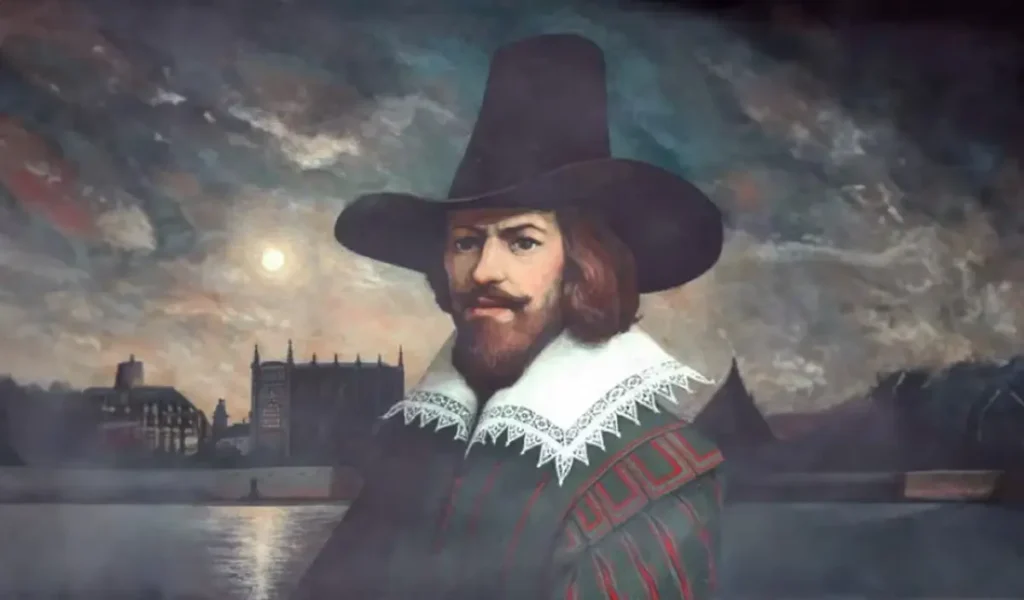

Who was Guy Fawkes? | Biography
Guy Fawkes was an English Catholic soldier and conspirator best known for his involvement in the Gunpowder Plot of 1605. The plot sought to kill King James I and members of Parliament by detonating explosives beneath the House of Lords. Fawkes was discovered guarding the gunpowder before the proposed explosion. His arrest became closely associated with November 5, a date still remembered in Britain through Bonfire Night commemorations.
Table of Contents
Fawkes was born in York, England, in 1570. He attended St Peter’s School, where other future plot participants also studied. His father was Protestant, while his mother’s second marriage connected the household with a Catholic family. As a young man, Fawkes adopted Catholic beliefs and gained military experience fighting with Spanish forces in the Netherlands. His experience with explosives made him useful to conspirators planning an attack in London.
Robert Catesby organized the conspiracy, and Thomas Winter recruited Fawkes in 1604. Fawkes used the alias John Johnson while posing as a servant in a property adjoining Parliament. The plotters eventually obtained an underground chamber beneath the House of Lords and stored 36 barrels of gunpowder there. Authorities received a warning and searched the premises. They discovered Fawkes and the explosives during the night before November 5, 1605.
After his arrest, Fawkes was imprisoned at the Tower of London and questioned under torture. He and surviving conspirators faced trial for high treason on January 27, 1606. Authorities executed him in Westminster on January 31, 1606, when he was about 35 years old. November 5, 2026, marked another annual commemoration of the historical event, not a newly discovered crime. Understanding his life requires distinguishing his actual subordinate role from centuries of popular legend.
Guy Fawkes Age | How Old Was Guy Fawkes?
About 35 years old, Guy Fawkes died on January 31, 1606, in Westminster, England. He was born in York in 1570. However, his exact calendar date of birth is not established with the certainty of modern records. Baptismal information places him in the spring of that year. His involvement in the Gunpowder Plot came during 1604 and 1605, when he was approximately 34 or 35. He was arrested on the night before November 5, 1605. His trial took place January 27, 1606, followed by execution four days later. His age remains an estimate based on the historically documented birth year.
Guy Fawkes Height | How Tall Was Guy Fawkes?
Guy Fawkes’s height is unknown. Sixteenth-century and early seventeenth-century records did not routinely publish standardized body measurements for individuals. Some surviving military muster rolls and comparable historical documents offered exceptions. The historical material examined describes Fawkes’s activities, clothing, interrogation, and role as an explosives specialist. It does not provide a trustworthy measurement in feet and inches. Later illustrations show him in recognizable clothing, but those artistic representations cannot prove his stature. Nor can the size of an arresting officer or a portrait’s proportions establish a measurement. Reporting an exact height would invent precision unsupported by surviving reliable historical documentary evidence.
Guy Fawkes Ethnicity | Was He English?
Guy Fawkes was English, born in York in 1570 within the historical Kingdom of England. His documented family, schooling, and later military career connect him with English society and the religious conflicts of his era. In present-day terminology, ethnicity is a complicated category to apply retroactively to a sixteenth-century individual. There is no reliable self-description using modern ancestry classifications. Historical accounts identify his English origins and Catholic religious affiliation rather than measurable ancestral percentages. His military service for Spain did not make him Spanish by birth. Likewise, Catholicism described his religion, not an ethnic group. These distinctions preserve historical accuracy.
Guy Fawkes Education | St Peter’s School in York
Guy Fawkes attended St Peter’s School in York during his youth. The school also educated John and Christopher Wright, who later became involved in the Gunpowder Plot. Contemporary biographies associate Fawkes with that educational environment. However, his complete school record is not preserved in the form of a modern transcript. His later military service suggests he acquired practical skills useful for handling weapons and explosives. However, that experience should not be rewritten as a formal engineering degree. Universities, standardized certificates, and professional qualifications operated differently in his era. The reliable education fact is his connection to the York school before his soldiering years.
Guy Fawkes Wife | Was He Ever Married?
No marriage has been established for Guy Fawkes through the principal parliamentary and historical records reviewed. Those accounts explain his childhood, military experience, political contacts, arrest, and execution. They do not supply a reliably documented wife’s name or marriage date. Some popular retellings attribute relationships to historical conspirators without surviving evidence sufficient to verify them. The absence of a named spouse in available research is not conclusive proof that he never married. Nevertheless, adding a specific woman to his family biography would mislead readers. A historically responsible account leaves the marital question unresolved while emphasizing events supported by contemporary records and scholarly interpretation.
Guy Fawkes Children | Did He Have a Family?
Guy Fawkes has no reliably verified children in the principal records examined for this article. His documented life ended in January 1606 after the failure of the Gunpowder Plot. The evidence that survives concentrates on his parents, schooling, religious associations, military work, and involvement in the conspiracy. It does not provide authenticated birth records identifying his sons or daughters. Family traditions and later fictional representations are not replacements for contemporaneous documentation. An exact number of children cannot reasonably be asserted. The historical story can be told without inventing descendants or connecting living people to Fawkes through an unsupported family tree.
Guy Fawkes Family | Parents and York Childhood
Guy Fawkes was born in York to Edward Fawkes and Edith Jackson. His father was a Protestant, while his mother later married into a Catholic family. The religious shift in the household provided part of the background for Fawkes’s eventual conversion to Catholicism. His upbringing occurred during an era of severe religious and political tension in England. The family had connections within York society, and Fawkes attended St Peter’s School there. Published historical accounts also identify siblings, although details about each relative vary in surviving records. A careful family account separates these documented relationships from imagined motives and unsupported claims about inherited wealth.
Guy Fawkes Career | Soldiering for Spain
Before joining the Gunpowder Plot, Fawkes served as a soldier with Spanish forces fighting in the Netherlands. England and Spain were major political and religious rivals, and service abroad placed Fawkes among militant Catholic networks. He acquired experience with military operations and explosives, which made him valuable to the conspirators. Parliamentary history describes his reputation for technical expertise despite not holding a senior military command. He also discussed the possibility of Spanish intervention in England with Catholic contacts. By 1604, Thomas Winter had recruited him into a domestic plot led by Robert Catesby. His activities were military and conspiratorial rather than a salaried modern profession.
Guy Fawkes Gunpowder Plot | Who Organized It?
Robert Catesby was the principal organizer of the Gunpowder Plot. Disappointed by the treatment of Catholics under James I, he proposed destroying the political leadership at Parliament’s ceremonial opening. Thomas Winter helped recruit Guy Fawkes in 1604. Other conspirators included Thomas Percy and the Wright brothers. The group originally considered tunneling toward Parliament, but later rented an undercroft beneath the House of Lords. Thirty-six barrels of gunpowder were placed there. Fawkes assumed the disguise of John Johnson and took responsibility for guarding the explosives. He was a crucial participant, not the sole author of the plan. The intended explosion could have killed many people beyond the political targets.
Guy Fawkes Arrest | How Was the Plot Discovered?
Authorities received an anonymous warning commonly called the Monteagle Letter. Its message raised suspicions about the planned opening of Parliament on November 5, 1605. Officials searched the building and surrounding premises. During an early inspection, they encountered Fawkes near firewood and initially accepted his explanation. A later search found concealed gunpowder, leading to his arrest. Fawkes identified himself as John Johnson, maintaining his false identity. Interrogations followed, and King James I authorized torture on November 6. Later statements helped officials pursue other conspirators. These events occurred across the night before the planned explosion, explaining the strong historical association with November 5.
Guy Fawkes Death | Why Was He Executed?
Fawkes was convicted of high treason after trial in Westminster Hall on January 27, 1606. The government alleged participation in a conspiracy to kill the king and destroy Parliament. He and other surviving plotters faced the severe penalties imposed for treason at that time. Historical records describe execution arrangements involving hanging, drawing, and quartering. Fawkes was executed at Old Palace Yard in Westminster on January 31, 1606. The sentence and the authorities’ use of torture reflected the harsh criminal practices of seventeenth-century England. His conviction followed the discovery of explosives and investigation, not a successful explosion. The planned mass attack never occurred.
Guy Fawkes Night | Why Is November 5 Remembered?
November 5 is observed in Britain as Guy Fawkes Night, also called Bonfire Night. The occasion commemorates the discovery of the 1605 Gunpowder Plot, not the anniversary of Fawkes’s execution. Bonfires, fireworks, and sometimes effigies became associated with the date over subsequent centuries. On November 3, 2026, parliamentary records attracted coverage before the commemoration. They included the 1605 Thanksgiving Act, which called for church services on November 5, and an early Commons journal documenting the gunpowder discovery.
The documents formed part of a large transfer of parliamentary archives to the National Archives at Kew. The historical collection included an official description of 36 barrels of gunpowder found beneath Parliament. This anniversary explains renewed interest in Fawkes’s identity, religion, arrest, and the plot’s failure. His name is also associated with the later Guy Fawkes mask used in cultural and political imagery. The 2026 anniversary was not a new criminal case involving him.
Guy Fawkes Salary | Did He Earn Money?
Guy Fawkes did not receive a modern salary that can be translated accurately into a present-day annual employment figure. His recorded activities included military service in continental Europe and involvement with a secret political conspiracy. Soldiers of his era might receive compensation under arrangements unlike contemporary employee contracts. However, no authenticated personal payroll record reviewed here establishes Fawkes’s yearly earnings. Currency, purchasing power, and economic institutions also changed dramatically after 1605. Converting a guessed seventeenth-century amount into American dollars would create misleading precision. His life is better understood through documented military responsibilities and historical conditions than through invented income figures.
Guy Fawkes Net Worth
Guy Fawkes’s personal net worth cannot be calculated reliably from surviving evidence. His lifetime preceded modern financial disclosures, standardized wealth reporting, and the concept of a celebrity fortune. Historical records concentrate on his family, military service, political associates, and punishment. They do not provide an audited list of his assets and debts when he died in 1606. Family property or payments related to soldiering cannot automatically be attributed to him personally. Modern currency conversions would require specific original amounts and a transparent method, neither established here. Accordingly, a numerical dollar estimate would misrepresent both the evidence and seventeenth-century financial conditions.
Biography Summary Table
| Category | Details |
|---|---|
| Full name | Guy Fawkes |
| Alternative name | Guido Fawkes |
| Birth year | 1570 |
| Birthplace | York, England |
| Date of death | January 31, 1606 |
| Age at death | About 35 |
| Nationality | English |
| Ethnicity | English; modern categories not documented |
| Height | Not documented |
| Religion | Roman Catholic (converted) |
| Father | Edward Fawkes |
| Mother | Edith Jackson |
| School | St Peter’s School, York |
| Profession | Soldier |
| Foreign military service | Spanish forces in the Netherlands |
| Plot leader | Robert Catesby |
| Recruiter | Thomas Winter |
| Conspirator alias | John Johnson |
| Gunpowder discovered | Night of November 4–5, 1605 |
| Proposed target | King James I and Parliament |
| Trial | January 27, 1606 |
| Execution site | Old Palace Yard, Westminster |
| Marriage | Not reliably established |
| Children | Not reliably established |
| Salary | Not documented |
| Net worth | Not calculable from reliable evidence |
| Annual commemoration | Guy Fawkes Night, November 5 |